Intravenous catheterization is a common practice for administering fluids directly into the blood stream. It is often associated with a lethal and a very frequent complication of Catheter-related bloodstream infection (CRBSI).
Catheter-related bloodstream infections (CRBSI) are defined as the presence of bacteraemia originating from an intravenous catheter. CRBSIs are a leading cause of nosocomial infections associated with morbidity, mortality, and cost.
Managing CRBSI:
The general way of managing CRBSI associated with any local or systemic inflammation is to remove the catheters from patients and initiate antibiotic therapy empirically. Chlorhexidine gluconate impregnated transparent dressings are being used to cover and protect catheter sites and secure devices to the skin.
Do You Know? Chlorhexidine belongs to the group of antiseptic antibacterial agents. It is primarily used to cleanse the skin after an injury, before surgery, or before an injection. Chlorhexidine works by killing (bactericidal) or preventing the growth of bacteria (bacteriostatic) on the skin. It can even be used to clean the hands before a procedure.
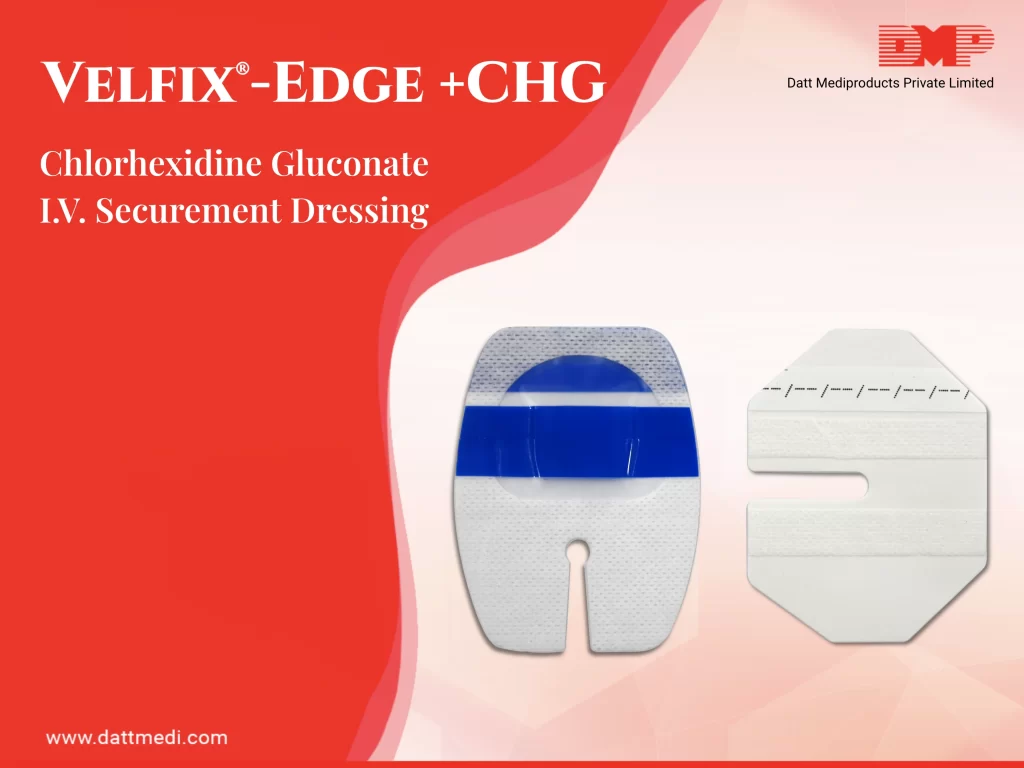
We present Velfix® -Edge+CHG, a Chlorhexidine Gluconate IV Securement Dressing. It comprises of a Stabilization Non-Woven Border, Antimicrobial Protection, High MVTR Transparent Film, a Notch, Securement Tape Strips and Documentation Label.
Antimicrobial Protection offered by Chlorhexidine Gluconate which is effective in protecting against catheter tip colonization. As per the study published in The American Journal of Medicine, “Chlorhexidine has a broad spectrum of antibacterial activity against Gram-positive bacteria, Gram-negative bacteria, aerobic bacteria, anaerobic bacteria and fungi, and the use of chlorhexidine for skin disinfection in ICU patients reduces the spread of microbes and the incidence of CRBSIs”.
Stabilization Non-Woven Border maximizes securement, breathability & wear time of the dressing.
High MVTR Transparent Film acts as a waterproof sterile barrier to external contaminants. MVTR is Moisture Vapour Transmission Rate is the measure of permeability for vapour barriers. Velfix® -Edge+CHG is a high MVTR dressing which allows excess moisture to evaporate through the dressing while maintaining proper securement.
Velfix® -Edge+CHG comes with 2 Securement Tape Strips to enhance the securement while promoting consistent application.
A Notch is provided for opening to host the cannula’s port & reduces risk of catheter dislodgement.
Documentation Label is a Pre-printed label to note dressing changes.
PROPERTIES & BENEFITS:
Highly conformable to provide solutions for difficult catheter and IV sites
Window frame design of Velfix® -Edge+CHG allows continuous observation of IV site
Offers waterproof sterile barrier to external contaminants because of high MVTR transparent film
Stabilization non-woven borders maximize securement, breathability & wear time
Notched design discourages edge lift
Velfix® -Edge+CHG is very easy to handle with gloved hands allowing single handed application
Made with a premium 30 μ high MVTR transparent Polyurethane film
EO Sterile
Chlorhexidine gluconate (CHG) aids in infection reduction.
Conforming & durable
Leaves no adhesive residue on skin post removal
USE: Velfix® -Edge+CHG can be used for the securement of Central Venous Catheters, IV Catheter sites, Dialysis catheters, Hickman/ Broviac catheters, Epidural catheters, Arterial catheters, Short peripheral and midline venous catheters. Velfix® -Edge+CHG comes in various customized sizes with varying CHG gel pad sizes for different IV devices.
Yes, even a small cut can become infected if it isn’t cleaned and protected properly. Most minor cuts heal without complications, but bacteria can enter through broken skin and, in some cases, cause infection or deeper tissue problems.
Cuts and scratches are part of daily life, from cooking and gardening to shaving and minor accidents. The good news is that simple first aid can help protect a minor wound and support normal healing.
This blog explains why early wound care matters, the five basic first-aid steps, what to avoid, and the signs that mean a cut needs medical attention.
Why Does Early Wound Care Matter?
Cleaning and protecting a cut early helps remove dirt and reduce exposure to bacteria, friction and further injury.
When the skin breaks, the body’s protective barrier is. Prompt wound care can help reduce contamination and give the skin a cleaner environment to repair itself.
Delayed or inadequate care can contribute to:
Increased risk of infection
Slower healing
Increasing redness or swelling
Further irritation or injury
In some cases, a deeper infection
How Does a Small Cut Become Infected?
A cut can become infected when bacteria enter through broken skin and multiply in the wound or surrounding tissue.
Common sources of contamination include:
Dirt, dust or soil
Unwashed hands
Contaminated surfaces
Dirty tools or objects
Animal or human bites
The risk is higher when a wound is deep, contaminated or difficult to clean.
Normal Healing or Infection? How Can You Tell?
Mild redness, tenderness and a small amount of clear fluid can occur during normal healing. Increasing redness, swelling, warmth, pain or pus indicate infection.
Sign
Normal Healing
Possible Infection
Redness
Mild and limited around the wound
Spreads outward or becomes increasingly pronounced
Pain
Gradually improves
Becomes worse or increases
Swelling
Mild and gradually settles
Increases or becomes increasingly warm/tender
Discharge
Small amount of clear or pale fluid
Pus or cloudy/foul-smelling discharge
Other
Gradual improvement
Fever, red streaks or feeling unwell
The direction of change matters. A wound that is gradually improving is generally less concerning than one that becomes increasingly painful, red or swollen.
How Does Early Protection Help a Wound Heal?
A clean, appropriately covered wound is protected from dirt, friction and further injury while the body’s natural repair process takes place.
Early protection can:
Reduce exposure to dirt and contamination
Protect the wound from friction
Reduce repeated touching or picking
Help maintain an appropriate healing environment
Protect newly forming tissue from further injury
The dressing should be kept clean and changed according to the needs of the wound and the dressing being used.
How to Treat a Small Cut: 5 First Aid Steps
For a minor cut, wash your hands, control the bleeding with direct pressure, rinse the wound with clean running water, cover it with an appropriate dressing, and monitor it for changes.
1. Wash Your Hands
Clean your hands before touching the wound or dressing.
This helps reduce the chance of introducing additional bacteria.
2. Stop the Bleeding
Apply firm, continuous pressure with sterile gauze or a clean cloth until the bleeding stops.
If blood soaks through the first layer, add more gauze or cloth without removing the original layer.
Seek urgent medical care if heavy bleeding does not stop with firm, continuous pressure or if the wound is deep or severe.
3. Rinse the Wound
Rinse a minor cut with clean running water to remove dirt and debris.
Avoid aggressively scrubbing the wound. Harsh substances can irritate healing tissue.
4. Cover the Cut
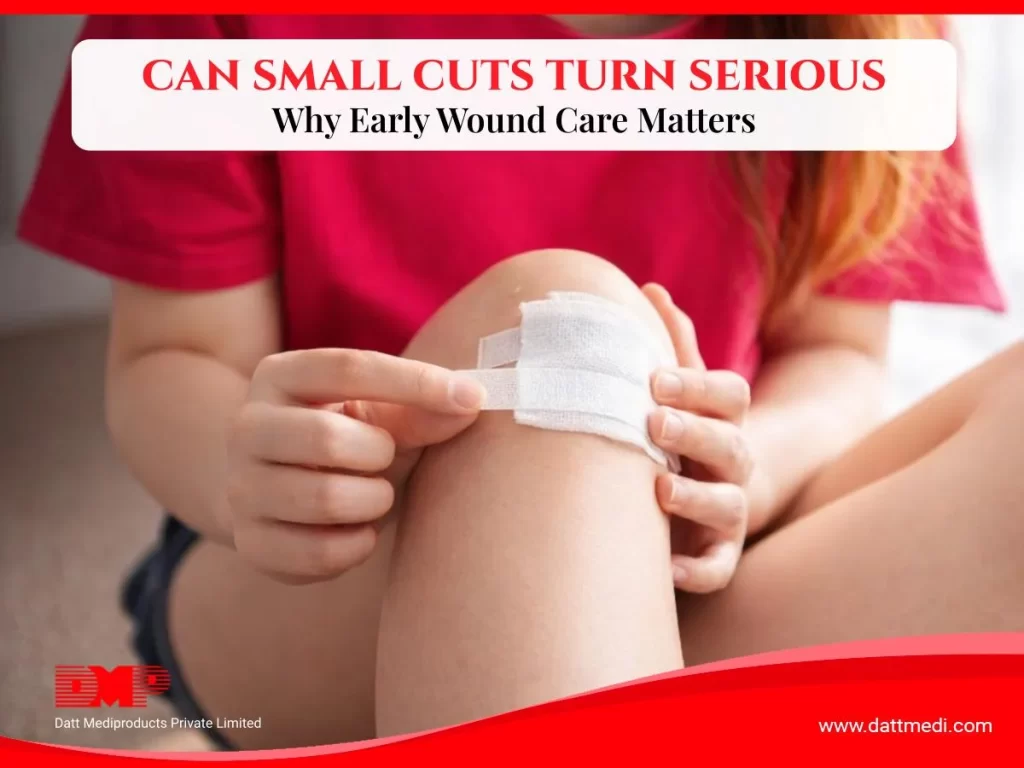
Cover the wound with a clean, appropriate dressing to protect it from contamination and friction.
Don’t place dirty or loose materials directly onto the wound.
For most minor cuts, gentle cleaning with clean running water and appropriate protection is a better approach than repeatedly applying harsh products.
When Is a Small Cut No Longer a Minor Wound?
A cut needs medical assessment when it is deep, gaping, heavily contaminated, continues bleeding, was caused by a bite or puncture, or develops signs of infection.
Seek medical advice if:
Bleeding does not stop with firm pressure
The wound is deep or gaping
Dirt or debris remains embedded in the wound
The injury was caused by an animal or human bite
The wound is a puncture injury
Redness or swelling continues to spread
Pus or unusual discharge develops
Pain becomes increasingly severe
You develop fever or red streaks near the wound
The wound is not improving after several days
You are unsure whether your tetanus vaccination is up to date
People with diabetes, poor circulation or a weakened immune system may need earlier medical advice because these conditions can affect wound healing and elevate the infection risk.
When Should You See a Doctor for a Cut?
See a healthcare professional when a wound is deep, difficult to clean, won’t stop bleeding, shows signs of infection, or occurs in someone with a condition that can delay healing.
Prompt medical assessment is particularly important when a wound is caused by a bite, puncture or contaminated object.
Tetanus protection also depends on the type of wound and vaccination history. The CDC’s wound-management guidance provides further information about tetanus prevention after injuries.
Can Small Cuts Become Serious in People with Diabetes?
Yes. A small wound can require closer attention in people with diabetes because reduced sensation or circulation can delay detection and healing.
Check the wound regularly and seek medical advice if it is not improving, becomes increasingly red or swollen, develops discharge, or shows other signs of infection.
This is especially important when reduced sensation makes it difficult to notice pain or injury.
Early Care Can Prevent Bigger Problems
A small cut does not usually become a serious problem, but early cleaning, appropriate protection and regular monitoring can help reduce complications.
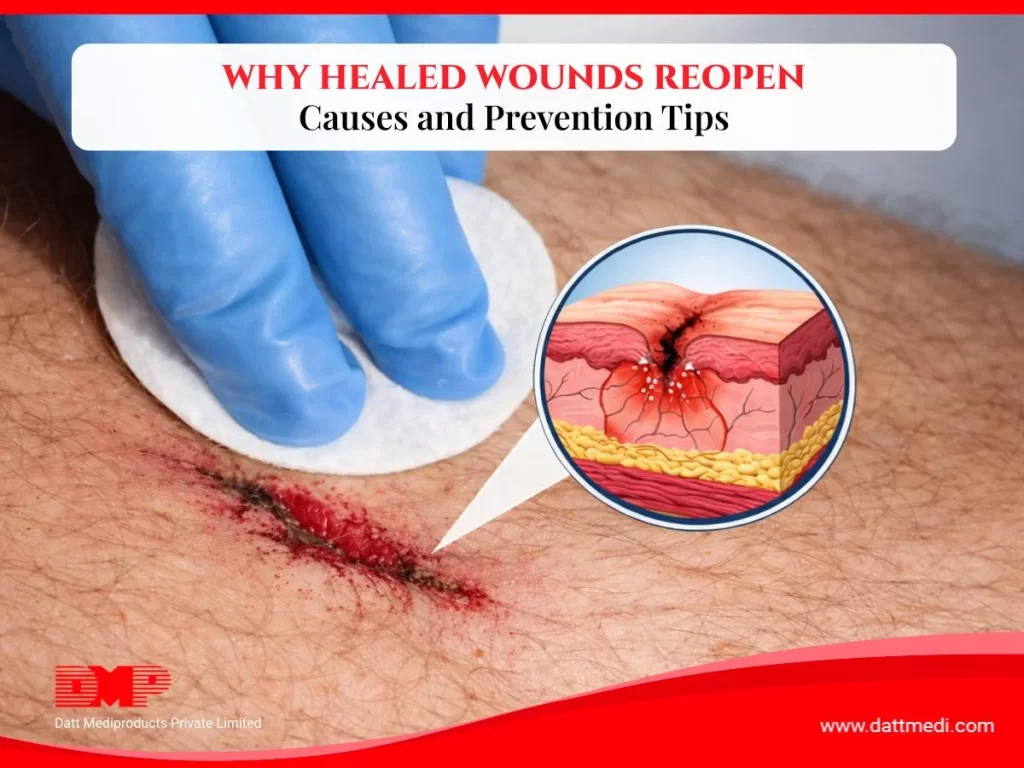
A wound that looks closed on the surface is not the same as wounds that has finished healing. The skin beneath may still be fragile, thin, and far less resilient than the tissue surrounding it. This is the stage where wounds most commonly reopen — not because something went wrong, but because the final phase of healing was not properly supported.
Understanding what makes newly closed skin vulnerable, and what protective measures actually work, can make the difference between a wound that heals completely and one that breaks down again.
Why ‘Closed Wounds’ Does Not Mean ‘Healed’
Wound healing happens in four overlapping stages: haemostasis, inflammation, proliferation, and remodelling. When the wound appears to close, the body is typically entering the remodelling phase — where collagen fibres reorganize and the new tissue gradually strengthens.
This phase can last several weeks to several months. During this time, the repaired skin has significantly lower tensile strength than normal skin — often as little as 50–80% of the original tissue strength, even after full remodelling. In the early weeks after closure, that figure is even lower.
The practical implication: the skin looks fine but cannot tolerate the same level of stress, friction, or pressure that healthy skin can. This is why reopening happens — not from neglect, but from the invisible vulnerability of newly repaired tissue.
The Most Common Reasons Healed Wounds Reopen
1. Mechanical Stress on Fragile Tissue
Areas that move repeatedly — knees, elbows, ankles, knuckles — place constant tension on healing tissue. Even normal daily movement can stretch new collagen fibres beyond what they can tolerate, causing the wound edges to split. This is particularly common in sutured wounds where the closure relies on the tissue holding together under movement.
2. Friction from Clothing or Surfaces
Repeated low-level friction from fabric, footwear, or contact with surfaces can erode the surface of newly healed skin. Unlike healthy skin, which can handle this without damage, fragile remodelling tissue has little resistance. Wounds on the feet, lower legs, or any area in contact with clothing are especially at risk.
3. Removing Dressings Too Early
Once a wound closes, it is easy to assume that dressings are no longer needed. In practice, premature removal of protective cover exposes the area to exactly the mechanical stress and friction described above. The wound may look healed, but the underlying tissue has not yet reached the strength to handle unprotected exposure.
Both extremes cause problems. Excess moisture — from wound fluid, sweat, or frequent washing without adequate drying — softens the surrounding skin (maceration), making it far easier to break down under light pressure. Very dry skin, on the other hand, becomes rigid and prone to cracking, particularly over joints. Maintaining a balanced moisture environment under and around the dressing is a key part of protecting fragile tissue.
5. Pressure on Immobile Areas
For individuals with reduced mobility, sustained pressure on a single area — particularly bony prominences like heels, sacrum, or hips — can cause tissue breakdown even in areas that appear to have healed. Regular repositioning and pressure redistribution are essential in these cases.
How Film Dressings Protect Wounds During the Remodelling Phase
Post-operative film dressings are one of the most effective tools for protecting healed and near-healed wounds during the remodelling phase. Unlike gauze-based dressings, which are primarily designed for wounds that are still actively healing and producing exudate, film dressings are specifically suited to closed wounds that need surface protection rather than absorption.
The key properties that make film dressings appropriate for this stage wounds are:
Breathability — allows moisture vapour to escape, preventing maceration without drying the tissue
Transparency — the wound can be visually monitored without removing the dressing
Flexibility — conforms to joints and body contours, maintaining protection during movement
Waterproof — the wound stays protected during bathing and daily activity
Datt Mediproducts offers three film and post-operative dressings suited to different stages and wound types in the remodelling phase.
Velfix® T-Film — Transparent Film Dressing
A thin, fully transparent PU film dressing designed for closed wounds that no longer produce exudate. The transparent film allows visual inspection of the wound at any time without disturbing it. Velfix® T-Film is waterproof, breathable, and flexible enough to move with the skin across joints and mobile areas. Available in sizes from 5×7.5 cm to 10×35 cm.
Best for: Sutured wounds, minor cuts and abrasions, and wounds in mobile areas such as knees or elbows that need protection without bulk.
Velfix®-Easy+Pad — Film Dressing with Non-Adherent Pad
Combines a transparent film border with a central non-adherent absorbent pad. This makes Velfix®-Easy+Pad suitable for wounds in the later stages of healing that may still produce minimal fluid, or where the wound surface needs a non-stick contact layer to prevent trauma on removal.
Best for: Post-operative wounds in early recovery that are nearly closed but may have light residual drainage.
Velfix®-T+Pad — Film Dressing with Higher Absorbency
Similar in structure to Easy+Pad but with a higher-absorbency central pad. This is the appropriate choice where some exudate management is still needed alongside the protective film border.
Best for: Wounds transitioning from active healing to the remodelling phase, where light-to-moderate fluid output continues.
Choosing the Right Film Dressing for the Wounds Stage
Situation
Velfix® T-Film
Easy+Pad
T+Pad
Wound fully closed, no fluid
✓ Ideal
Suitable
Unnecessary
Minimal residual drainage
Not sufficient
✓ Ideal
Suitable
Light-moderate exudate
Not suitable
Borderline
✓ Ideal
Joint or mobile area
✓ Ideal
✓ Suitable
✓ Suitable
Needs visual monitoring
✓ Ideal
Partial
Partial
Practical Care Tips for the Remodelling Phase
1. Keep the Area Protected Until the Skin Is Fully Strong
Resist the instinct to leave the area uncovered once the wound looks closed. A film dressing provides protection with minimal bulk and does not interfere with daily activity or bathing.
2. Monitor Without Disturbing
The transparency of film dressings means you can check for redness, fluid accumulation, or early signs of breakdown without peeling back the dressing. Only remove when the dressing edges lift, the dressing is full, or at the interval recommended by your healthcare provider.
3. Watch for Early Warning Signs
Address these promptly rather than waiting to see if they resolve on their own:
Redness or warmth spreading from the wound edges
Skin that looks shiny, wet, or softened around the dressing
Small cracks appearing at the wound edges
Increased tenderness or a pulling sensation when moving
Most of the attention in wound care goes to the early stages — cleaning, closing, and dressing the wound. The remodelling phase gets far less focus, but it is where a significant number of wound breakdowns occur. Newly closed skin is fragile, and the stress of normal daily life is often enough to cause reopening without adequate protection.
Film dressings provide a practical, low-profile solution for this stage. Transparent, waterproof, flexible, and gentle on removal — they allow recovery to continue without restricting movement or requiring complex care routines.
Browse the Velfix® T-Film and post-operative dressing range at Datt Mediproducts to find the right option for your stage of recovery.