Search by Blog
Read by Category

Your healing journey continues beyond this blog

Find the right products for better recovery at online store
Cart Image
Bandages Short Stretch vs Long Stretch

We all are aware that wound healing is more complicated than just wound assessment and treatment. To select the most appropriate bandaging system, one must understand the concepts of extensibility, recoil, and working and resting pressures.

Till date, little research has been done to investigate the best combinations of bandages or different bandage application techniques. We totally rely on clinical experience and tradition.

So, we thought to share some details to help you understand bandaging principles and to effectively treat and heal wounds.

  • Extensibility: is stretchability, the maximum amount a bandage can stretch. So for example, if a 3-meter bandage has 100% extensibility it would stretch up to a maximum length of 6 meters.
  • Recoil: is to regain. Once you stretch a bandage and release the stretch, it should come back to it’s original length. You can tell the quality of the bandage by its recoil, all good quality bandages will go back to its original length.
  • Working pressure: The bandage pressure on the limb when the limb is in an active state; for example standing, walking, etc.
  • Resting pressure: The bandage pressure on the limb when it is in an inactive/ resting state; for example lying down or sitting down.

 Some of the benefits bandages provide:

  • Reduce swelling by applying Intense therapy sessions.
  • Long-term use when certain individuals cannot wear compression garments.
  • Helps to control swelling symptoms in patients with complex medical issues.

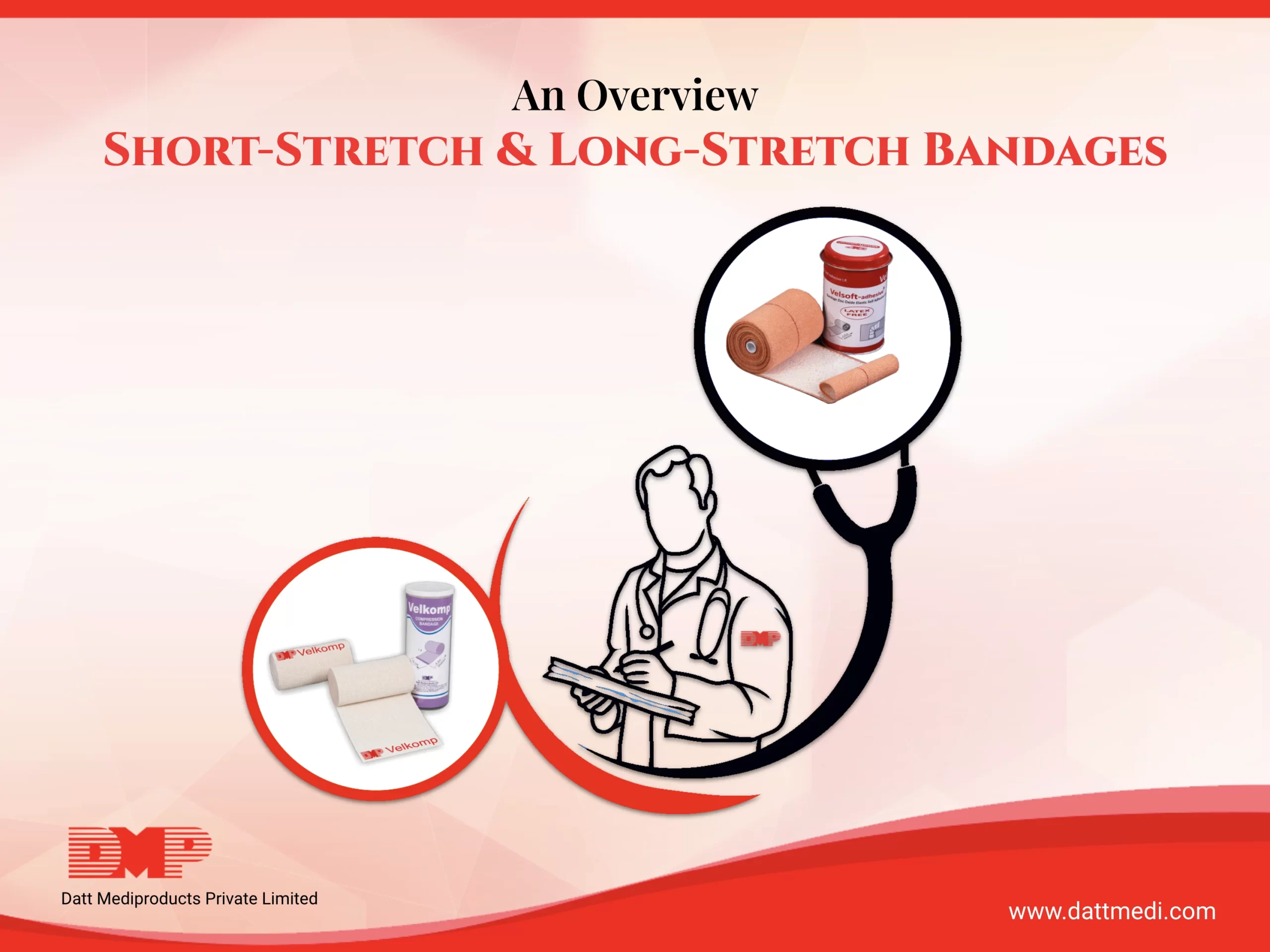
The compression bandages are mainly of two distinct types – the long stretch and the short stretch ones.

Long-stretch also known as Elastic bandages
Long stretch bandages contain elastic yarn which allows them to stretch more than 100% of the initial original length. They can be applied smoothly and will conform according to the contour of the body.

Short-stretch also known as Low-elasticity bandages
The short stretch bandages, however, are composed of cotton fibers. These fibers are interwoven so that the original length can be extended by almost 60% at the time of usage. The main advantage of the short stretch bandages is that they provide high working pressure that is necessary for lymphatic drainage as well as venous flow.

Extensibility: Short-stretch vs. Long-stretch bandages

Short stretch bandages are made out of 100% breathable cotton. Because of the way they are woven it causes interlocking of the fibers and results in a higher compression. Thus they are more effective for a higher working pressure. Being reusable and easily washable they end up being quite economical for people suffering from venous edema, lymphedema, post-traumatic swelling, etc. Most commonly short stretch bandages are used for vascular insufficiency, as it acts like a calf muscle to pump blood/ lymph towards the heart.

Long-stretch bandages have fibers which stretch as edema increases. They have high extensibility and recoil. Most commonly long stretch bandages are used to treat sprained areas of the body. They are often used to provide support and relief to tendons, ligaments, and muscles. Depending on the grade of bandage that is used, elastic systems may need to be taken off at night since the pressure that they exert is difficult to tolerate when sleeping.

Consultation with your Doctor
Doctors will help guide you in choosing the most appropriate bandage for your condition and also make sure that the bandaging is done using the correct technique. He/She will also guide you on how to take proper care of your bandages.

Before starting any type of compression therapy, Datt Mediproducts recommends to consult with a doctor or undergo a comprehensive clinical assessment. Compression therapy is contraindicated in individuals with certain diseases and conditions, so it’s best to check that you don’t fall into any of these categories before you start bandaging. To know more about these bandages, visit us @ www.dattmedi.com

Stay Safe! Stay Healthy!
Visit www.dattmedi.com for more infomation.
Share:
Recent Blogs
Comparing Orthopedic Casts

When it comes to managing fractures, the choice of cast material can make a significant difference in a patient’s recovery experience. Orthopaedic casts are essential in ensuring that broken bones heal correctly by providing the necessary immobilization. Two popular options in the medical field are Fiberglass and Plaster of Paris (POP) bandages. But how do they compare? Let’s dive into the details.

A. Material Composition: The Building Blocks

The fundamental difference between these two types of bandages begins with what they are made of:

  • Fiberglass is a synthetic material, made from plastic fibers coated with a resin. It’s known for being lightweight and is often available in various colors, which can add a bit of personality to an otherwise clinical experience.
  • Plaster of Paris is made from a fine white powder called gypsum. When mixed with water, it forms a thick paste that hardens as it dries.

B. Application Process: Ease vs. Skill

Applying these bandages requires different techniques:
  • Fiberglass bandages are dipped in water, applied to the injury, and begin hardening almost immediately, which allows for quick and efficient application. This makes it easier for healthcare providers to mold it perfectly to the patient’s body.
  • Plaster of Paris bandages need to be soaked in water and take longer to set. While they require more skill to apply, they offer a smooth finish that many patients find comfortable.

C. Durability and Strength: Which Lasts Longer?

When considering durability:
  • Fiberglass is the champion of strength. Its resistance to wear and tear makes it ideal for active individuals or cases requiring long-term immobilization.
  • Plaster of Paris is less durable, with a tendency to chip over time, making it better suited for short-term casts or initial treatments.

D. Comfort and Breathability: Feeling at Ease

Comfort is a top priority for patients who need to wear a cast for an extended period:
  • Fiberglass is lighter and less bulky, which adds to the patient’s comfort. However, it can sometimes be less breathable, leading to potential discomfort in hot or humid climates.
  • Plaster of Paris is bulkier and heavier, but it’s smooth finish can be more comfortable for some, allowing the skin to breathe better.

E. Setting Time and Ease of Use: Quick vs. Steady

The time it takes for a cast to set is crucial:
  • Fiberglass sets in just a few minutes, enabling patients to resume limited activities sooner.
  • Plaster of Paris takes much longer, often up to 15 minutes, which can be a disadvantage when immediate mobility is needed.

F. Water Resistance and Hygiene: Keeping It Clean

Hygiene is another critical factor:
  • Fiberglass is water-resistant, making it easier to maintain and less likely to harbour bacteria.
  • Plaster of Paris does not resist water and can easily disintegrate if exposed to moisture, requiring patients to take extra precautions to keep it dry.

G. Cost and Accessibility: Budget Matters

Cost and availability can influence the choice:
  • Fiberglass is typically more expensive and may not be available in all healthcare settings.
  • Plaster of Paris is more affordable and widely accessible, making it the go-to option in many clinics and hospitals, especially in resource-limited settings.

H. Environmental Impact: Think Green

With growing awareness about environmental impact:
  • Fiberglass, being a synthetic material, is less eco-friendly and can pose disposal challenges.
  • Plaster of Paris is derived from natural materials and is more environmentally friendly, though proper disposal is still necessary.

I. Clinical Applications: The Right Cast for the Right Case

  • Fiberglass is often recommended for long-term use and in cases where the patient is likely to remain active.
  • Plaster of Paris is ideal for short-term immobilization or initial treatments, particularly when budget constraints are a concern.

Making the Right Choice : Choosing between Fiberglass and Plaster of Paris bandages depends on several factors, including the patient’s lifestyle, the duration of immobilization, and budget.

Fiberglass is generally favoured for its durability and water resistance, while Plaster of Paris remains a trusted option for initial and short-term care due to its affordability and ease of use.

For more insights and to explore our range of orthopaedic casting products, visit our website: Velcast™ – Orthopaedic Fiberglass Casting Tape, Osteopop™ – Plaster of Paris Bandage and Velpop® – Plaster of Paris Bandage. Discover the best solutions for your orthopaedic needs today!

Advantages of Using Velfix®࿯ T+Pad for Post Surgical Wounds

In the field of post-surgical wound care, innovation plays a crucial role in ensuring optimal healing outcomes and patient comfort. Introducing Velfix® -T+Pad, a groundbreaking solution that redefines the standards of wound dressings. Meticulously designed and crafted, Velfix® -T+Pad stands at the forefront of advanced wound care technology, offering not only healing but also unparalleled comfort and convenience.

Waterproof and Bacterial Barrier Properties:

Among the essential features of wound dressings, waterproofing and bacterial barrier stand out. Velfix® -T+Pad not only meets these requirements but surpasses them. Its impermeable yet breathable film forms a protective shield against water and bacteria, safeguarding the wound from external threats and fostering a hygienic healing environment.

Benefits of Continuous Visual Monitoring: 

The advantage of transparent film dressings is the ability to visually monitor the wound without removing the dressing. This allows healthcare providers to detect early signs of infection: clinicians can quickly spot signs of infection, excessive drainage, or other complications, facilitating prompt intervention. It also aids in exudate management : ensuring that the wound exudate is being effectively absorbed and does not pose a risk to the healing process.

Conforming to Body Contours:

Comfort is paramount, especially in areas prone to movement or swelling. Velfix® -T+Pad addresses this need adeptly. Its flexible design seamlessly conforms to the body’s contours, providing a snug fit without compromising comfort. Whether it’s a joint, a curve, or a crease, Velfix® -T+Pad stays in place, ensuring uninterrupted healing.

Effective Evaporation of Moisture:

Moisture management is critical for wound healing, and Velfix® -T+Pad excels in this aspect. Thanks to its innovative adhesive pattern, it facilitates efficient moisture evaporation from the wound bed. This not only keeps the area dry but also prevents maceration, creating optimal conditions for healing.

Reducing Pain Upon Removal:

Dressing changes can be painful, but Velfix® -T+Pad aims to alleviate this discomfort. Featuring a non-adherent pad, it minimizes trauma upon removal, reducing pain and discomfort for the patient. With Velfix® -T+Pad, dressing changes become a smoother, more tolerable process, enhancing the overall patient experience.

In the realm of post-surgical wound care, excellence is imperative. With its innovative design and advanced technology, Velfix® -T+Pad sets a new standard for wound dressings, offering a comprehensive solution that prioritizes healing, comfort, and convenience. 

From its waterproof and bacterial barrier properties to its transparent film for easy monitoring, Velfix® -T+Pad epitomizes cutting-edge wound care. Trust in Velfix® -T+Pad to deliver not only healing but also peace of mind, ensuring a smoother, swiffer path to recovery for patients worldwide.

Logo

Datt Mediproducts Private Limited

Loading