Knee compression supports are one of the most commonly used orthopedic aids — for good reason. They reduce swelling, provide joint stability, and allow people to stay active during recovery. But picking the wrong one delivers less benefit than it should.
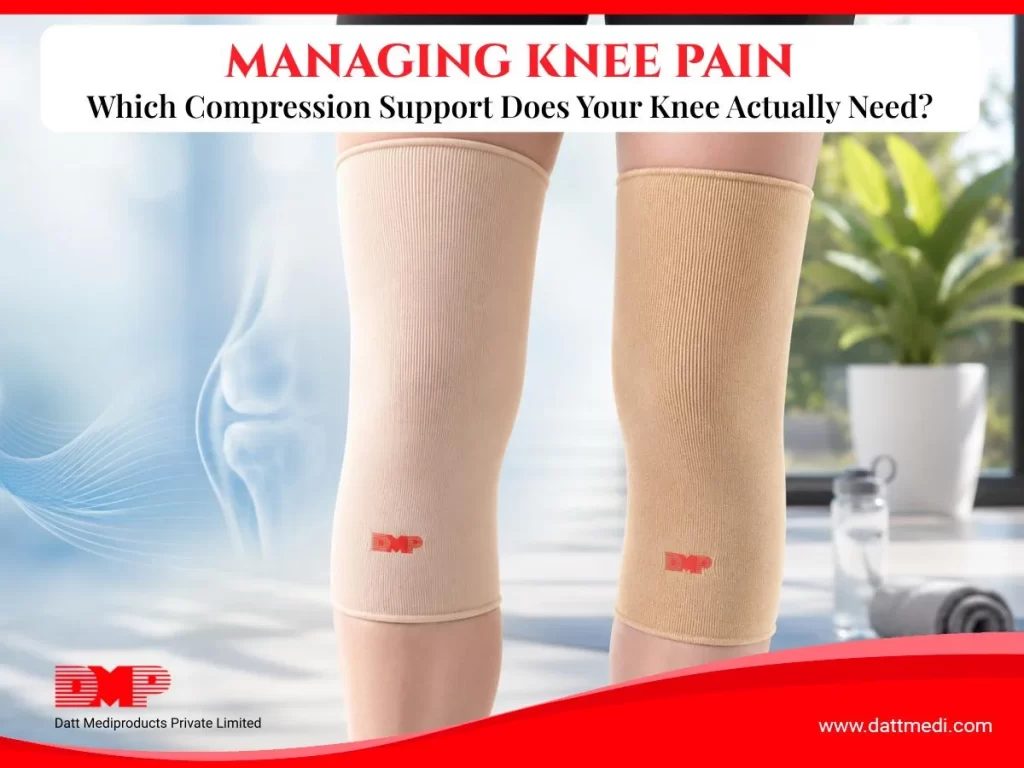
The Datt Mediproducts range includes two knee compression supports: the Knee Cap® and the Knee Cap Classic®. Both share the same anatomically tapered form and four-way elasticized construction, but differ in material composition — and that difference matters for fit, stretch, and the conditions each handles best.
This guide breaks down both products clearly so you can match the right support to the right situation.
Understanding Knee Compression Supports
Before comparing the two products, it helps to understand what knee compression supports actually do — and what they don’t.
A compression sleeve works by applying graduated pressure around the knee joint. This pressure does three things: it reduces fluid accumulation in the surrounding tissue (reducing swelling), it improves preconception — the joint’s sense of its own position in space — which improves stability and coordination, and it provides mild structural support to the muscles and ligaments surrounding the joint.
Compression sleeves are not rigid braces. They do not prevent movement or immobilize the joint. Their role is to support the knee while allowing full, natural range of motion — making them suitable for both active use during daily activity and recovery phases where movement is encouraged.
Knee Cap® vs Knee Cap Classic®: What Is Actually Different?
Both products share the same core design: anatomically tapered, four-way elasticized fabric, breathable moisture-transporting weave, beige color, and easy pull-on application. Available in S to XXL (37–67 cm thigh circumference). The key difference is material composition.
| Feature | Knee Cap® | Knee Cap Classic® |
| Material | Polyamide, Polyester, Cotton, Nylon, Spandex, Rubber | Polyamide, Polyester, Cotton, Rubber |
| Key differentiator | Contains Spandex + Nylon — higher elasticity and stretch recovery | No Spandex — firmer, more structured fabric |
| Compression feel | Softer, more flexible compression — moves freely with the joint | Firmer, more structured compression — greater sense of support |
| Best for | Active use, exercise, long-duration wear, mild-to-moderate conditions | Recovery, post-operative support, instability, conditions needing firmer hold |
| Indications | Arthritis, swelling, sprains, ligament/muscle injury, post-op, weak knees | Arthritis, swelling, sprains, ligament/muscle injury, post-op, weak knees |
| Sizes | S, M, L, XL, XXL | S, M, L, XL, XXL |
| Colour | Beige | Beige |
Knee Cap® — When to Choose It
The inclusion of Spandex and Nylon gives the Knee Cap® a higher degree of stretch and elastic recovery. The fabric moves with the joint rather than resisting it, making it more comfortable for extended wear and higher-activity use.
Best suited to:
- Daily activity support — long hours of standing, walking, or commuting
- Exercise and sports — where full range of motion is needed alongside compression
- Mild-to-moderate swelling from arthritis or overuse
- Sprains and strains in active recovery, where movement is encouraged
- Individuals who have worn a rigid brace and are transitioning to lighter support
- Long-duration wear where breath-ability and comfort are priorities
The four-way stretch and moisture-transporting weave make it particularly well-suited to warmer climates or extended wear through a full workday.
Knee Cap Classic® — When to Choose It
Without Spandex, the Knee Cap Classic® fabric is slightly firmer and provides a more structured feel against the joint. For some users — particularly those managing instability or recovering from injury — this firmer hold provides greater confidence during movement.
Best suited to:
- Post-operative knee support — where firmer compression is preferred in the early recovery phase
- Ligament injuries — where the joint needs a stronger sense of containment
- Knee instability — where proprioceptive feedback from firmer compression helps prevent giving way
- Arthritic pain management — particularly where the joint feels loose or unpredictable
- Individuals who find softer sleeves feel insufficient for their level of discomfort
The Classic’s firmer structure makes it the better starting point when someone is first introducing compression support and needs the reassurance of a more defined hold.
Clinical Indications: Both Products
Both the Knee Cap® and Knee Cap Classic® are indicated for the same range of conditions. The choice between them is about compression feel and activity level, not about which conditions they cover.
- Arthritic knee pain — reduces swelling and improves joint comfort during movement
- Swelling from injury or post-operative recovery — graduated compression reduces fluid accumulation
- Ligament and muscle injuries — supports the surrounding soft tissue during healing
- Sprains and strains — protects the joint during active recovery
- stabilization of weak knees — improves preconception and confidence during weight-bearing
- Post-operative knee support — provides compression during the rehabilitation phase
How to Size Correctly
Both products are sized by thigh circumference, measured approximately 15 cm above the center of the kneecap. An incorrect size is one of the most common reasons compression sleeves under perform — too loose provides minimal compression; too tight restricts circulation.
| Size | Inches | Centimetres |
| S | 14.8 – 17.2″ | 37 – 43 cm |
| M | 17.2 – 19.6″ | 43 – 49 cm |
| L | 19.6 – 22″ | 49 – 55 cm |
| XL | 22 – 24.4″ | 55 – 61 cm |
| XXL | 24.4 – 26.8″ | 61 – 67 cm |
Safe Use Guidelines
When to Wear It
Compression sleeves are designed for use during periods of activity and weight-bearing — standing, walking, exercising. Most people do not need to wear them at night or during extended rest periods. If your clinician has advised otherwise, follow their specific guidance.
Combining with Rehabilitation
Compression support works alongside rehabilitation — not instead of it. Quadriceps strengthening, hamstring flexibility, and hip stability exercises address the underlying muscle weakness that contributes to knee instability and pain. A compression sleeve manages symptoms during activity; exercise addresses the cause.
Signs the Fit Needs Adjusting
- Sleeve rolls down or bunches behind the knee — size may be too large
- Visible skin bulging above or below the sleeve — size may be too small
- Numbness, tingling, or increased swelling below the knee — too tight, remove immediately
- No perceptible compression when standing — fabric has lost elasticity, replace the sleeve

Related reading: From the Field to Recovery: Orthopedic Injury Essentials for Athletes
When Compression Is Not Enough
Compression sleeves are appropriate for a wide range of common knee conditions. However, some situations require more rigid structural support than a sleeve can provide:
- Significant ligament instability (ACL, PCL, MCL, LCL tears) — typically requires a hinged brace
- Meniscal injuries with mechanical symptoms (locking, giving way) — requires clinical assessment
- Post-operative immobilisation immediately after surgery — rigid brace or cast typically prescribed
- Fractures or bone stress injuries — require immobilisation, not compression
If you are unsure which level of support your condition requires, consult a physiotherapist or orthopedic specialist before selecting a product.
Choosing the Right Support from the Start
The difference between the Knee Cap® and Knee Cap Classic® comes down to how the compression feels against the joint and what activity level the sleeve needs to accommodate. For flexible, active, long-duration use — the Knee Cap®. For a firmer, more structured hold during recovery or instability — the Knee Cap Classic®.
Both are sized S to XXL, both are breathable and pull-on, and both cover the full range of common knee conditions. The right one is the one that matches how your knee feels and what you need it to do.
Browse: Knee Cap® | Knee Cap Classic®
Related reading: The Role of Orthopedic Support Products in Arthritis Pain Management